Monday, December 17, 2012

A Visit to the Bosque - November 2012

Again we visited the Bosque to share the full moon and cool weather with an abundance of snow geese and sand-hill cranes, and the occasional heron or bobcat, but also with an abundance of other photographers from all over the U.S. and Canada, all with expensive lenses that looked like something you'd see poking out from a hummer in a middle-eastern war zone.
  Obviously it ain't fair to complain about other citizens of the republic enjoying our shared public land; but there were a great many of them.  When you're shooting video, so that as well as visual record of the critters you're recording the sounds of quarrels and cries and flapping wings, it ain't fun to come home editing out a constant chatter about people's meals, health, camera equipment, and itinerary.  So fair or not, I wish you'd all stay away next year -- or stop jabbering the whole time.  The rat-a-tat-tat of motorized cameras all around me is bad enough, particularly when a crane actually flies right in front of the moon.
  Having said that, most people tried to quiet down a bit when I politely mentioned my plight.  They forgot pretty quickly, but they tried.
  Besides which, if you're a photographer and life puts a bunch of other photographers in your way, then you might as well start photographing photographers.  I've done so in a variety of sometimes comic situations -- a big, bearded European tourist on an island in Lake Titicaca shooting a close-up of a little girl with a lens that was longer than she was tall; a couple of Asian tourists, surrounded by the vast beauty of Yosemite,

taking snapshots of each other; Japanese girls photographing sakura blossoms with their cell-phones.  In other spots, including Death Valley, where almost no one else was around, the inclusion of a lone photographer with his or her tripod in a vast expanse of sand helped communicate the scale and loneliness of the scene.

So I do routinely photograph the photographers, and sometimes even send them the images later.

While I'll still always prefer seeing and hearing no one else (except Dael) anywhere around, sometimes a photographer's intentness on her subject might communicate something I'd not have been able to get across without her.

  Besides which, how could i be irritated with the gent disturbing the peace of the snow geese at right, when his stroll into their midst yielded images of them in flight?

  (As it happened, we talked with him later.  He said usually when he walked along that bank the birds just slipped into the water, which was what he was hoping to photograph.)

  Meanwhile, we have our routine down: we pack carrots and sandwiches and plenty of water for the drive North, arriving in Socorro in time to check into a motel by mid-afternoon, then head back down for a late-afternoon / early evening shoot, featuring the full or nearly-full moon rising majestically above the mountains beyond the cranes as the cranes settle in for the night; supper at the coffee house, the huge Mexican restaurant, or on sandwiches in our room; off-load video and stills; get up before dark to join the snow geese and cranes before the sun does; videotape the full moon falling and the birds awakening and flying off, sometimes in great torrents, for the day; breakfast at the coffee house; another late afternoon / early evening shoot, with the full moon rising about 42 minutes later than the previous night; another night in Socorro, then another early morning of moonfall and sunrise and birds, ending in a regretful start back toward home.
  Answers to FAQ's we get (or questions I'd have if I read the preceding paragraph):
      -- from Las Cruces to the Bosque is a couple of hours' drive; if going directly to the Bosque, cut off I-25 and do the last 20-30 miles on Route 1 (El Camino Real), which is windy, rural, and less-traveled -- and means you don't drive on past the Bosque to San Antonio and then double back a few miles;
      -- San Antonio is the I-25 exit for the Bosque coming from Albuquerque or Socorro; San Antonio has two inviting places to eat (though not for non-meat-eaters), the venerable Owl Cafe and the Buckhorn Saloon, both famous for green-chile cheeseburgers, but no motel or hotel;
      -- the coffee house is on Manzanares Street, and offers great omelettes and coffee and pastries and an exceedingly comfortable place to hang out for hours (to get there from the Bosque, take the first Socorro exit from I-25 and head North on California Street, the main drag, keeping an eye out for Manzanares Street, then turn left on that toward the plaza but make another left into the parking lot as you notice the side of the building there has a mural on it -- that's the place);
      -- if you don't want to spend the middle of the day lounging in the coffee house, going home to nap, or processing your photographs and writing, there are plenty of neat side-trips you can make between the early morning and late afternoon visits to the birds:
                  1. you can drive slowly around the Bosque, as we did in January, or hike around in there;
                  2. you can head East on U.S. 380 through the Malpais to the ghost town of White Oaks or to Lincoln, both famous in Billy the Kid / Lincoln County War lore.  (The Malpais National Monument is volanic lava dried into weird looking shapes, a stark and strange landscape that's worth a look, even though the caves are currently closed because of a bat-killing fungal disease);
                  3. the Very Large Array ain't too far away, but aside from making that idiotic rhyme I have little to say on that subject yet;
                  4. you could, as we did this time, drive West on 60 to Magdalena, enjoy the countryside and look around the town, then continue West toward Datil and the Wilderness or drive up to the small Navajo Reservation somewhat North by Northwest of Magdalena; or
                  5. you could explore another refuge such as Sevilleta, which we hope to do one one of our next visits.
Sunrise from just North of the Flight Deck - Bosque del Apache
The birds are mostly sleeping when we arrive.  They awaken slowly (except when a train lumbers past), and seem in no hurry to head out for their day's foraging.

Sometimes we find the snow geese and cranes slumbering in the same pond.  The snow geese awaken
A high-contrast vision of morning in the Bosque
first, and make an incredible racket, as if they were debating the day's plans, definitely without a copy of Rogers Rules of Order.

The cranes slumber on.   Eventually they awaken and contribute to the cacophony.   They stand around in groups, or in pairs, and eventually the more ambitious of them being walking, in
Moonfall with Sand-Hill Cranes - Bosque del Apache
their oddly ungainly gait.  While others remain motionless, increasing numbers walk, almost all of them in a single direction.  They pause now and then to eat, but then continue, toward the direction in which they will eventually take off, as if jockeying for position.  Mostly they don't get in each other's way, but occasionally a minor quarrel gets one or both of the participants jumping up and down, making a
Cranes Are Flying

good deal more noise, and flapping their wings violently until one or the other gives up.

Meanwhile the moon flees for cover and the sun creeps up over the horizon.

The cranes keep walking.  A few strays fly in from another pond to join the party.  The noise-level rises.

"Let's go, guys!  Time's a-wasting!"
Then sometimes singly, or in pairs, or in small groups, they begin flying.  Generally the cranes all take off in the same direction.  Although they seem to us to have been moving forward to get a good position, it's not always the ones at the North end of the group who take off flying North first.  Sometimes a pair from somewhere in the middle will suddenly rush forward a few steps
and take off, at first flying just a
foot or two above their neighbors' heads.  Sometimes the ones remaining in the water ignore them, sometimes they watch, sometimes one or two will take off to join them.  Then more standing around, more desultory snacking on whatever it is they like under the shallow water, more striding forward.


Stragglers
The rhythm of departures rises and falls as if some unknown station manager had assigned everyone his or her flight time, and communicated those times in some fashion wholly unknown to mere humans.  If the cranes are sharing the pond with snow geese, there will come a time when the departures come more and more quickly, culminating in the sort of mass fly-off I've mentioned in
earlier posts, and even included a video (with apologies for quality) of hundreds or thousands taking wing at once, all bragging about it at the same time.

Almost always there are stragglers among the cranes.  Dozens or hundreds of cranes fly off on urgent business, leaving fewer and fewer standing around in the pond.

Sand-hill crane gives another a piece of his [bird-brained?] mind

Some of these stragglers begin to act as if they plan to spend the whole day here.  Vast majorities of both cranes and photographers have long since disappeared, and a few cranes still stand around, or stroll about stealing snacks from beneath the water-surface, or discuss whatever they discuss with
the same desultory mood of a half-empty cafe in a small Texas town on a weekday morning,

But the second crane looks distinctly unconvinced.
with just the retirees still hanging about with nowhere to go.

Eventually they too will lean to the side, then forward, then get a running start and lift-off.

Of course, many of them fly a very short distance. While some explore dozens of miles to the north or south, many land n the nearest field.  A drive through the
Bosque or North toward San Antonio will provide plenty more photo-ops for visitors, although the light becomes a good deal less interesting real fast.

The guys at left have lingered awhile in the shallows not too far north of the wooden viewing area called "The Flight Deck."


Similarly, only a couple of human beings remained at the spot.


Periodically we see a bobcat or coyote, or watch a coyote stalking around a field near one of the ponds, as reminders of why the birds are so careful to sleep out in the middle of a pond at night.  This weekend we saw a bobcat, and during the early morning at one of the ponds we heard coyotes howling.

By late afternoon, we're back, wandering among the same ponds and fields, shooting video of the birds.   The light grows richer by the minute, until the sun disappears and the moon rises and the birds settle down for the night.
     
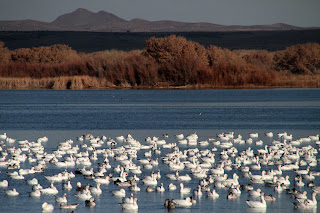
Snow geese back home by late afternoon


More snow geese at another pond


A crane joins his pals


A snow goose looks for a suitable landing spot . . .


A crane and his reflection stroll off in search of a snack.


After Sunset


A killdeer walks on the moon

When I get a chance, I'll upload video from these trips to the Bosque.  That's what I concentrated on; and though from moment to moment it could be frustrating -- training the camera for long periods on cranes I hoped would start moving, only to give up just before they took off; hearing quarrels and panning to them too late to get more than the tail end of the incident; following birds from their first appearance over the horizon to circling, approach, and landing while trying to keep the camerawork as steady as possible -- things worked out well enough often enough to yield some decent sequences.

Saturday, December 15, 2012

A Visit to the Bosque - October 2012


In January, we visited the Bosque del Apache.  There were still plenty of sand-hill cranes and snow geese, and a surprising number of eagles, and a coyote pacing around at sunset, frustrated by the birds' habit of bedding down out in the middle of a pond, beyond his easy reach.  

At dawn, with the full moon falling toward the horizon, we watched the birds awaken.   At first they slumbered.  Then the snow geese made an incredible racket, while the sand-hill cranes miraculously appeared to sleep on.  Eventually, as the moon disappeared, the snow geese swept into the sky, in a great cacophany of flapping wings and screeches, covering the sky almost completely.   Enthralled, I shot the whole thing on videotape.  I was hooked.  (The January post has the video, unedited -- fast-forward to about the two-minute mark and watch the last 50 seconds for the fly-off.)

I resolved immediately to be there every full moon from September 2012 to January 2013.  We skipped September because bad weather up in the Bosque would have made videotaping pointless -- and moonless; but we made it in October; and although mostly I was shooting video, this post contains stills from 28-30 October, mixed in with a travel tip or two.

Autumn lent the scene a special richness.


Full Moon Rising - 28 October


Morning - 29 October


Four consecutive exposures of these guys taking off.
When we returned in the afternoon,
this fellow was watching the snow geese

Moonrise - 29 October


Cranes Flying - Morning of 30 October

Flying Cranes Reflected


Friday, December 14, 2012

Road Trip to Marfa

We finally got to Marfa not long ago.

Our friend Noam (whom I've known since his birth in Las Cruces in 1975, but who now lives in London) is there as a sort of "artist in residence" at a gallery run by some European foundation. 

We were there only about 18 hours, and most of the time when we weren't asleep we were walking and talking with Noam, shooting pool and talking with Noam, dining in a fancy restaurant and talking with Noam, or sitting around at the gallery space where we all slept. 

Nevertheless, I did shoot pictures, mostly while walking and talking, or at least walking and listening.
Marfa has a population of about 2100, and is very far from anywhere, unless you count Valentine, which has about a third of that population, or Alpine (the home of a team that plays against the Las Cruces Vaqueros in an independent minor league no one outside West Texas or southern New Mexico has heard of), or Fort Davis to the north on state highway 17 -- or Big Bend, which we'll visit next month, I hope.

Yet it has some galleries and restaurants you'd be more likely to find in San Francisco or London than in a wide spot on Texas State Highway 90.  My sister and brother-in-law have even read of Marfa in the New York Times.

Anyway, I carried my camera.
. . .


The last picture show flickered off here a long time ago . . .


. . . and this modern art is on the fender of a pickup truck
that left Detroit early in my childhood


On closer examination Marfa might be a strange place, with its mixture of artsiness and small-town Texas.  Noam lives in London, and the folks who run the gallery he's at are European; but when we walked passed the football field he noted that he'd attended a Friday night football game that could have come straight from the television series.

We didn't see much of the arty side, but thoroughly enjoyed the two bars in which we shot pool.  One even had shuffleboard.

We did hear the train come through at about two or three in the morning.


Saturday after breakfast we hit the road again, returning by a less direct route to take a look at the countryside north of Marfa.

Barely beyond the city limits we paused to photograph a distant windmill -- and noticed, as you can see in the closer shot below, the Border Patrol blimp that sits above a section of Highway 90 watching the border.  We'd passed under it the
previous day.  It must be an odd day's work, hanging around up there looking through binoculars, or whatever they do!

On the other side of the road, up a slight grade, a horse grazed on the horizon.   Later it seemed more elemental as a pseudo-painting than as a photograph, though. 


This was just hanging on the fence as we neared Fort Davis


She was a rancher's wife (and professor of mathematics) who
paused to chat with us when we stopped by the skeleton


Fort Davis turned out to be a strangely evocative little place, at least in the strong winter sunlight that day.  Trees.  Craggy cliffs overlooking part of the town.  More than a few old places, some of them in disrepair and some nicely done up for the tourists, with several looking as if they had interesting stories to tell.

Surrounding the courthouse, the constable, the court reporter, and other functionaries all had their parking spaces clearly marked.


The street then came to a dead-end at a cliff, and in that setting and that light the church looked so inviting I might have gone in and prayed awhile if it had been Sunday.

Then we made our way through town and out the other side, where Fort Davis itself -- the national historical site -- boasted a set of huge cottonwoods so old that they were roped off and a sign warned folks that branches or trees could fall at any time.

Fort Davis is in Jeff Davis County, in the Davis Mountains, but the pretty countryside more than made up for the local lack of imagination about place-names.

Sunday, December 9, 2012

New Mexico Should Legalize Marijuana Now

During my first year of college I knew slightly a kid named Bennett Hertzler. A gentle, harmless sort of guy. In a police search of dormitory rooms, he was caught with three or four marijuana seeds in a desk drawer – and sentenced to years in jail. While the rest of us continued our college educations, Ben languished in prison. It destroyed his life.

Could have been me. I smoked marijuana when I was young. Liked it fine. Then one evening, as I smoked, I became convinced that I was dying. In fact, I was fine physically, but I was sure I was dying, for about a half an hour. Thereafter, whenever I smoked the same thing happened. The pleasant high just wasn’t worth the miserable fear I had to go through first, and I was busy with professional tasks and obligations anyway, so I stopped. But I have friends who continued smoking for decades without any apparent problem, and still do so. Some are grandparents. 

Should marijuana be illegal?

Marijuana is relatively harmless. It doesn’t make people violent or, so far as I can discover, cause them serious medical problems.

Studies show that driving a car while high on marijuana is far less dangerous than driving while high on alcohol. Alcohol abuse over decades leads to serious illness and even death.

It is said that marijuana use by kids leads to use of stronger and more dangerous drugs. That can be true, primarily because the society that prohibits marijuana (a) tosses kids who want to smoke into the company of people who also sell other illegal drugs and (b) does so with propaganda that undermines our credibility when we tell kids about the very real dangers of more powerful drugs. It’s like telling kids that masturbation causes blindness, then expecting to be believed when we explain later why it’s important to avoid unprotected casual sex.

The Alcohol Prohibition didn’t work. While perhaps a noble experiment, it made drinking alcohol more fun, killed or injured people who drank bad booze, decreased respect for laws, increased corruption, enriched criminals, and generally caused new problems while failing miserably to solve the original one.

The Marijuana Prohibition doesn’t work. It leads to broken lives like Ben Hertzler’s, decreases respect for law, costs society an amazing amount for enforcement, trials, and prison space, enriches criminals, and prevents people from smoking marijuana that’s either homegrown or grown by someone licensed and inspected. It also keeps people who live in pain from easy access to marijuana’s ability to lessen that pain.

This is what we said decades ago and were thought crazy.

More recently, these thoughts have become more acceptable. A blue-ribbon panel of former public officials from all parties reached the same conclusion about the War on Drugs. Fifteen states have decriminalized marijuana. Three states voted this year to legalize it.

Here’s the choice: spend vast sums of money in bad economic times to arrest, try, and imprison people for something they do in their own homes, or legalize marijuana – and perhaps regulate it and tax sales.

Why do we choose one way regarding alcohol and differently for marijuana? Why do we do so even though alcohol causes greater driving impairment, a deeper addiction, and harsher medical issues than marijuana?

Initially, prejudice was part of the reason: our parents and grandparents had drunk alcohol, but marijuana was associated with blacks and later with the 1960's "counterculture."

The inequity persists because people with money like it that way: alcohol is big business; and selling marijuana illegally is far more profitable than selling it legally. Ending the marijuana prohibition would be devastating to cartels, which could no longer charge a "danger premium" to customers for something folks could grow it in their own homes.

Thus it’s heartening to see that a bill to lower penalties in New Mexico will be introduced soon.

It’s disheartening that if it passes Governor Martinez might veto it. That would be one more reflexively bad choice by our governor, who’s rapidly increasing her chance of serving only one term.

Martinez’s "defense" of her position sounds like an admission of misconduct.

Her press secretary says stiff marijuana penalties are good because "the vast majority of people convicted for possessing small amounts of marijuana are diverted to treatment programs, and those who are sentenced to prison are individuals with long criminal records with convictions for things like assault, burglary, and other crimes."

That is, these laws are great tools to put away folks with bad records against whom we can’t prove anything serious right now. For folks we approve of, it’s like driver education classes for speeders. Folks we don’t like could go to jail for several years.

That’s like criminalizing coffee and tea so that when you suspect someone of a crime but can’t prove it, or just don’t like someone, you can punish people you suspect of real crimes but can’t catch.

There was a time when students who questioned the wisdom of the war in Viet Nam or associated with folks of different "races" were thought dangerous and unpatriotic, but they had free speech rights. Small-minded district attorneys could do little. Conveniently, though, a lot of those rebellious young folks smoked marijuana, and could be imprisoned for that when the real complaint was their thought and speech.

That ain’t justice.
                                       -30-
[The column above appeared in the Las Cruces Sun-News this morning, Sunday, December 9th, under a headline chosen by the newspaper.

Of course, there's more to say:

First of all, some more specifics on the proposed bill, as reported very recently in the Sun-News and elsewhere:
-- an interim committee heard details of the proposal last Thursday;
-- a major supporter is New Mexico Drug Policy Alliance (Director Emily Kaltenbach);
-- the bill would eliminate the penalty of up to one ounce, and reduce possession of 2-8 ounces from a misdemeanor to a fine.
-- as yet, no state legislator has stepped up to sponsor the bill, although a few have spoken positively about it.  Those included Vietnam veteran State Rp. Eliseo Alcon (D-Milan), who said that "part of our world is opposed to anything that might make someone happy", and State Sen. Richard Martinez (D-Espanola).
Fiftenen states have decriminalized possession of small amounts of marijuana.


Secondly:

While no cogent argument against legalizing marijuana use by adults outweighs the clear benefits of doing so, marijuana use by minors raises significant issues.  Marijuana and certain other drugs can produce scary moments (as my own experience, related above, would suggest); rather obviously, marijuana can lead to temporary confusion, fear, or paranoia, or can undermine judgment; and marijuana use can also be so delightful that it's hard to resist toking up more often than one should, and kids are particularly ill-equipped to interpose judgment and restraint.   Obivously kids don't have the context and maturity to handle many emotional situations that adults should have. 

The state has a legitimate interest in keeping grass out of the schools. 

But how best to do so is a legitimate question.  Certainly the current efforts are a miserable failure, in that grass is readily available to kids and smoked by many in schools. 

I'm no expert, but my guess is that if legalizing marijuana made much difference it might actually improve the state's ability to discourage marijuana use among kids.

First of all, once kids no longer believe in Santa Claus and the Tooth Fairy, I think we do better with them by explaining honestly the dangers of certain conduct.  Lies and gross exaggerations may work in the short term with some kids; but in the long run even those kids will see through you -- and, being kids, conclude that you're probably being equally fatuous in many of your other warnings and proscriptions. 

Secondly, to the extent that legalizing grass would lead to regulated growing and selling of the stuff, those businessfolk who grew and sell might be as vulnerable as bartenders and liquor store owners to stiff penalties for selling to minors.  A store-owner selling marijuana has an investment s/he would prefer to protect, and fines and suspensions might, as with alcohol sales, have at least some positive results. 

Third, to the extent that other and much more dangerous drugs are our real concern, separating sales of those from sales of marijuana might slightly decrease their use among kids. ]


Sunday, December 2, 2012

Larry Hagman - A Las Cruces Appreciation


Larry Hagman, who died Friday, arrived in Las Cruces in 1970 to make a Hollywood movie.

When he showed up on the set and spotted the red sports car that would be used a lot in the film, he immediately suggested we go for a ride around the county in it. A lowly assistant to the director, I worried that we didn’t have permission. But he was one of the film’s stars.

We had a great ride. And toward the end, when he learned that it was my girl friend’s birthday, he gave me a joint for later. Recreational use of marijuana was a bigger illegality then than now, so I appreciated the gesture.

The film, spawned by an uneasy marriage between sexploitation studio and a serious and talented director named Ted Flicker, the movie made little money and was soon forgotten.

At the time, though, it featured two of the era’s biggest TV stars, each playing a character best-known for viciousness, greed, and dishonesty: Hagman, then known for "I Dream of Jeannie" but soon to be mega-famous as J.R. Ewing on "Dallas," played the conservative president of a southwestern university, and Joan Collins, later star of "Dynasty," played his wife.

(In the film, young man angry at Hagman because of a lost scholarship gets back at him by seducing his daughter, wife, and mistress. Initially called "High in the Cellar," the film’s name got changed by the studio first to "Up in the Cellar," to avoid such a brash reference to drugs, and later to "Three in the Cellar," to take advantage of the greater success of an earlier but utterly forgettable film by the studio, "Three in the Attic.")

The Hollywood cast and crew kept Las Cruces amused for a month or so; And I got to know and enjoy Larry Hagman and his wife Mai.

Larry was truly funny; and although he often played somewhat nasty right-wing figures, he was about as liberal, tolerant, and generally relaxed as anyone could be. The first time I saw him, he was telling a story about someone accusing him of being gay, and the punch-line was him telling the would-be gay-basher, "Well, if you are and you think I am, then come and give me a big kiss. Otherwise, it’s none of your business."

I’ve seen a few other stars on location. Many have their own trailer, and hide there from everyone else except when needed on the set. Larry and Mai had a trailer – or, more precisely, a Volkswagen bus or Dodge van with a great sound system – but he was always out throwing frisbees with NMSU students.

The van sticks in my mind because of the many evenings on which we rolled out to La Posta in it, smoking Larry’s good dope. The food there never tasted so good. Too, in those days there was still a pretty strong distaste among most folks for dope-smoking young rebels; and as one of those, I enjoyed the irony of sitting around a big table in the restaurant, stoned out of my mind, while various conventional citizens came up and introduced themselves to the famous actor, who managed to act suitably un-stoned.

[Disclaimer: I’m not suggesting anyone smoke marijuana, particularly anyone young, although certainly the stuff should be legalized before Prohibition helps bankrupt us and further enriches the drug cartels. Forget working for the Chinese, we’ll be working for the drug cartels in a decade or two.]

Larry was a talented actor and a wonderfully candid and funny man. I not only enjoyed our talks, but I appreciated his "un-Hollywood" nature. Mai, who was a wonderful woman, was as non-Hollywood-Glamour as anyone could be. If Larry had a big ego, I never saw it. He was just a regular guy.

Ironically, while he was as unlike his character as could be, Joan Collins – from my more limited contact with her – seemed every bit as bitchy as her on-screen character. I remember driving her to the El Paso Airport, in a Winnebagos we had rented for the shoot, listening to a steady stream of complaints about the director (whom I liked and respected), the conditions, and other members of the cast.

But Hagman was a delight, to everyone he met or worked with here.

                                                       -30-
[The foregoing appeared in the Las Cruces Sun-News today, Sunday, 2 December. ]

What I probably didn't manage to say clearly enough was that Larry Hagman, aside from being the consummate professional, was just a wonderfully warm, fun, imaginative, caring, curious, creative, and tolerant human being.   That made it ironic that he so often played complete S.O.B's such as J.R. Ewing (and President Camber in the film made here).