Sunday, May 8, 2016

Why We Need Wayne Hancock and Dr. David Garcia

Wayne Hancock is a dedicated and conscientious public servant, and voters should retain him as county commissioner.

We met recently at a small locally-owned coffeehouse. As Wayne went in to get his coffee, he spotted a couple of stray napkins blowing around on the patio. He bent over to pick them up, put them in the trash, then went in. 

He's that kind of guy. The opposite of pompous; and naturally inclined toward doing the right thing.
Hancock has tried to do right by Doña Ana County. He's proud the County's gone five straight years without a negative audit finding. He's proud they got a glass-recycling facility. 

The commission has also started a public transportation system for the south county. Rural folks, some old and/or poor, were missing medical appointments. (La Clinica Familia reports 60% no-shows outside the city.) Students were missing classes at DACC. 

Critics confuse this system, perhaps intentionally, with the larger one ($10 million annually in bonds) that voters rejected. This more modest program? El Paso Metropolitan Planning Organization recently chipped in $109,000, and the NM Department of Transportation $419,000. A $264,000 investment has met an obvious need – and brought in $528K. Ridership has increased steadily.

Anti-Hancock sound-offs, some basing their points on columns I've written criticizing the county administration, misunderstand (intentionally in some cases) the facts and the law. Mad at Hancock because you think Chris Barela broke the law? A few years ago, when I reported some of what I'd learned to enforcement authorities, Commissioner Hancock also reported what he knew. So he ain't in cover-up mode. He was concerned, as citizen and as commissioner. Mad that the county settled a lawsuit or took it to trial? Quite possibly the insurer (NM Association of Counties) made that decision. Not the commission.

I do question the conduct of some county officials. Some county employees say Julia Brown should fire Debra Weir, then resign. I'm not sure they're wrong; but commissioners may know things we don't. It may be that the commission, in moving more deliberately and carefully, is make a better decision, based on the whole picture. Their care and deliberation could help avoid a lawsuit if they ultimately fire Ms. Brown. Running this county is complex. Employees are a major consideration, but not the only one. 

In four years Hancock has learned a lot about the complex mechanism that is our county government, and he's sincerely trying to improve it. We'd lose that learning if he left the commission. Same with Dr. David Garcia. Dr. Garcia is almost painfully sincere in his concern that things be done right. They're intelligent, thoughtful men with gumption and good instincts. That's more important than whether we agree on every issue.

A new commissioner trying to deal with the administration would be at a disadvantage. Meanwhile, Sheriff Kiki Vigil (who has warred with Brown and opined that Dennis Montoya would be a better manager) is actively backing three candidates. If elected, those three (if beholden to Sheriff Vigil) could fire Brown and hire Dennis Montoya. While Dennis is a smart guy, that's not the right solution. (I've tried to reach Vigil for comment.)

The key decisions that face us are more significant and complex than the bickering between sheriff and county officials. Mr. Hancock has a better grasp of those than his challengers, and has the maturity and strength of character to stand up against interests who would seek to abuse our precious and limited resources. That's why retaining Hancock and Garcia matters.

When we finished talking, Wayne bussed our table before I could even lend a hand.
                                                    -30-
 [ The above column appeared in the Las Cruces Sun-News this morning, Sunday, 8 May, and on the newspaper's website.  It will also appear presently on the KRWG-TV website.  I welcome comments, questions, and criticisms here or on either of those websites.]

[One note on the transportation system: There was a proposal for a transportation system that would have required something like $10 million in annually.  Voters rejected that, and made clear they thought it was way too expensive for this county.  The commissioners listened.  They put in place a system that should help meet the need but cost a fraction of the initial amount the voters rejected.  However, I should clarify my discussion of this in the column.  Apparently the $264,000 is what's been spent to-date.  (As of the end of April.)  Which in turn has netted $528,000 in grants.  The overall cost for the year should be another $56-$64,000 per month, depending on fuel costs and other variables.  Eight months at $60K each would be $480,000 -- a hell of a lot less than $10 million, but more than $264K.  On the other hand, there's a reasonable likelihood of further grants, too.  Thus I didn't want someone to attack this column by noting that $264,000 isn't the cost for the whole year; but it seems likely the ultimate cost, after subtracting out what grants cover, will be minimal.  That sounds like good business to me.]
[On Vigil and Montoya: I want neither to be an alarmist nor to ignore this point.  I can't say how likely it is that a revamped commission would fire Brown and replace her with Montoya.  What we know (from Sheriff Vigil himself) is that he is walking the streets for candidates in three districts, and has threatened current commissioners that they'll be gone.   If his candidates win, his level of control over them is another unknown.  Further, his reported remark that Mr. Montoya would be a better county manager than Ms. Brown may have been offhand.  Still, it's troublesomeUnfortunately, he didn't call me back.  I'd have liked to include his side on this.] 

Sunday, May 1, 2016

More Fireworks between County and County Sheriff


Tuesday was a long, difficult day, and hard to write about.

A county-hired consultant reported to the commission on why the sheriff's office has adequate numbers of personnel. Then a long parade of DASO personnel passionately disagreed. Later, DASO top brass attacked the study at a press conference. 

Sheriff calls consultant a hatchet-man, County says consultant is the best in the business – and authored a Department of Justice staffing document the Sheriff had relied on earlier. Consultant says 12-hour shifts are better than 10, Sheriff cites a study showing 10 is better than 12; consultant says 20,000 calls per year, DASO says 100,000. 

Who's right? Ask me after I investigate further.

More important: what's going on in this long-running dispute? 

Sheriff's deputies are angry. No raises for years – while a county-hired consultant working with the human resources department recommended raises for HR employees. (The raiselessness arose partly from the deputies' union's decision to focus on other issues.) Watching officers young and old leave for better-paying law-enforcement jobs. Working with old equipment. Deputy Ken Roberts demonstrated Tuesday how deputies often have to hold a radio as high as possible to make it work. 

The county administration is frustrated. I like Kiki Vigil, but sometimes his manner magnifies problems. Yesterday he stood up and loudly called Commissioner Billy Garrett a liar. (I looked into it, and found no lying. As usual, there were two differing interpretations of an ambiguous situation. Both Billy's view and Kiki's were honest, I think.)

Recently, using an outside vendor to repair cars, Sheriff Vigil exceeded the approved $10,000, and even the $50,000 the county manager had authority to approve. The commission was asked to approve all this after the fact, and declined. A law-enforcement official who dislikes both sheriff and commissioners told me a while back that the sheriff exceeded other budgets; and a commissioner privately confirmed that.

The sheriff says he's walking the streets in support of challengers for commission seats. He may not realize that some voters find it intimidating that a man with a gun is visiting to tell them how to vote. What also isn't clear is which came first: did his frustration with the county government lead the Sheriff to seek change, or did political considerations lead him to make honest differences more vitriolic than they needed to be?

Tuesday, most DASO personnel spoke pretty angrily to the commission. Mostly, the commissioners took it, with good grace. 

Garrett gave a long, heartfelt response, and made some good points, including a 25% increase in DASO's budget; but I cringed at his reaction to criticism that commissioners haven't ridden along with deputies: “Maybe I should do it, for the optics. But our job is making policy here,” was a troubling answer, from an otherwise great commissioner. 

It was hard to watch DASO officers bash commissioners for an hour. I know good people on both sides. Under the previous sheriff, some bad things happened to these officers. A few talked to me, and I wrote about it, despite threats to them and to me. I respect and like those officers. I've also talked at length with the commissioners. I respect and like them. We're lucky to have them serving – even if we don't agree on every issue. 

I'm not on any side. I'm telling friends at DASO that certain commissioners are trying really hard to be excellent public servants, and are doing a lot of good. And I'm telling friends on the commission that many of those deputies were yelling from honest frustration, not mean-spiritedness. A ride-along could only enhance understanding.
                                                            -30-

 [The column above appeared in the Las Cruces Sun-News this morning, Sunday, 1 May, and on the Sun-News website, and will be up shortly on the KRWG-TV website as well.   ]

[Let me make one thing clear: based on the past few years, I'd vote for the re-election of Wayne Hancock or Dr. David Garcia if I lived in their districts.  I say that despite having criticized the county administration on certain issues, notably the sluggishness with which county manager appears to have dealt with personnel issues and the concern among some county employees that despite her initial promise she's become part of the problem.  First of all, that isn't the only issue facing the commission.  There are many others, some of them complex.  These two men have brought integrity and experience to the table and have tried to deal with issues fairly and with good judgment.  By and large, they've done well.  And I trust them both.  Once you get past the slogans and sound-bites, they're both working hard to represent us well.]

[I do hope to look further into the staffing issue.  And other issues involving the sheriff's office and the county administration.   On the staffing issue, factual disputes such as the number of calls annually, as well as continuing discussions such as whether 10-hour or 12-hour shifts are best, should be easy to look into.
I disagree with the sheriff's side that the county commission had no business looking into the staffing issue: the commission had budget oversight and an HR department, the sheriff has made serious allegations about staffing levels, and the commission had every right to look into that.
But I wish the two sides could have agreed on a consultant and cooperated.  Under the circumstances (an ongoing civil war between sheriff on the one side and county manager and HR director on the other) there was every danger that hiring Mr. Weiss would look like an attack in that political civil war.  The commission did try for some cooperation, inviting District Attorney Mark D'Antonio to broach the subject with Mr. Vigil, and there was some discussion, but it isn't completely clear why that never bore fruit.  (I think the sheriff should have cooperated anyway; but I understand the feeling that it was a put-up job.)    
Aspects of the report and its presentation by the consultant did feel a little like watching an expert witness on one side in a trial -- someone who knows the field, but is clearly testifying on behalf of one side in a dispute.  I'll follow up by trying to ask the consultant, but his discussion of 9-1-1 calls is an example: the law (and logic) requires investigation of calls on which someone immediately hangs up, and  he seemed to be suggesting there were ways to cut down on those.  He recounted a situation in another town where 10% of the 9-1-1 calls turned out to be from a single hotel where people were trying to dial 9 then an outside number; but in a town this size, I gotta think someone would have figured that out if it were happening here.]
[Personal note: soon after I moved here, someone beat up someone else in the house I'd lived in in California; with my California cell-phone, I quickly dialed 9-1-1 -- then realized that of course the cell-phone would connect me with the jurisdiction I was physically in, not the one in the cell-phone's area code; so I hung up quickly, or explained to the person who answered what had happened.  About ten minutes later a DASO deputy showed up.  When my wife explained, he still politely insisted on coming inside to where I was and talking directly to me.  Otherwise, how would he know we weren't being held at gunpoint?]


Saturday, April 23, 2016

A Visit to the Site: Trinity

We recently visited the Trinity site for the first time. Site of the first atom-bomb blast, at 5:29:45 a.m., July 16, 1945. It's on White Sands Missile Range.

We saw Jumbo, a thick steel bomb-casing they didn't use; and we saw numerous photographs of the blast, and of soldiers and scientists working and playing here.

The bus contained many NMSU students from other countries. Several were Japanese – including one girl who had chosen NMSU partly because she might get to visit the site. (We met some great young students whose life NMSU is enhancing but who also enhance our community; and the tour seemed just the kind of imaginative venture NMSU should be doing.)

There were moments of humor. Warning us not to take pictures, our guide, Lisa Blevins, said, “You may see some very strange animals.” Three of us (at least) envisioned animals made strange by radiation. Lisa dashed our hopes by mentioning orix.

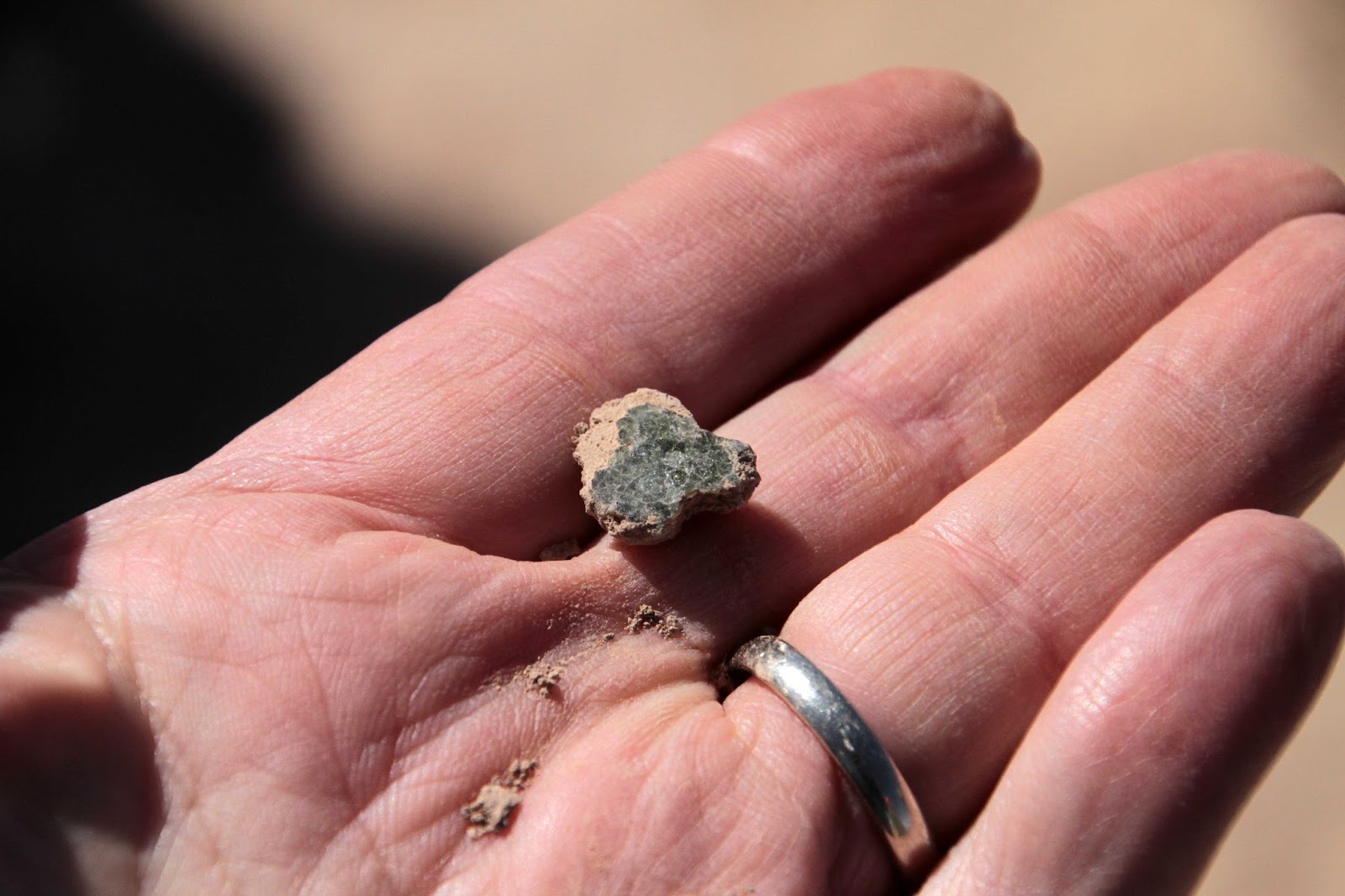
As folks picked up tiny pieces of Trinitite, green glass-like material created in the atomic blast, Lisa warned that there were also little round things we ought not to pick up and show her: rabbit droppings. (People actually do!) She also told us not to remove trinitite, “because we're not making any more.” 

People photographed each other, inside Jumbo or by the obelisk. A recent open-house drew 3,992 visitors.

In the McDonald ranchhouse, the master bedroom was a “clean-room” for attaching the bomb's innards. “The world changed in this room,” Lisa said. True, that.

Four years ago this week we visited Hiroshima. We saw the shell of a bomb-destroyed building. We visited the memorial with kids' bikes and baseball gloves and clothes as the bomb left them, as well as photos from those days of horror, and government documents. And photos from here. It was difficult, but moving, and seemed important. 

Trinity, where a bunch of good-hearted young American soldiers helped build that bomb, was another side of a complex coin. You look at these guys, lounging and laughing off-duty, or swimming in the stock tank, and they're just good kids . . . who happened to be working on something devastating. There's no blame. Not for them, anyway. For Japanese leaders, yes. Maybe some U.S. leaders, too.
My father, a pilot in the Pacific, told me of a father and son he knew pretty well. The son was a pal of my father's. His father was Arthur Compton, a famous physicist. Only after August 6 did father and son learn that both had been working on the same project. (Arthur Compton was so famous he used a false name on the project, “A.H. Comas.”)

The long-finished Manhattan Project spreads tentacles into many of our memories or family histories, particularly here. One acquaintance told us that one morning in July 1945 a guy came into her family's Las Cruces pharmacy, shaken. He'd been driving to Cruces in the early morning darkness. Excitedly he stammered, “The sun came up. Then it went back down!” The military explained the blast as an accidental munitions explosion; but New Mexicans knew better.

The McDonald ranchhouse has such rural simplicity it's hard to realize such momentous work occurred there. It's isolated in the southwestern desert we so love. Lisa said she likes taking her lunch out there and “pretending this is all mine.” 

Walking through the desert I felt the same peace (and the same uneasiness about that peace) as I felt walking the riverbank below that burned-out building in Hiroshima, watching a white heron fishing 70 years later. 

It's important not to forget what happened, there and here.
                                                     -30-

[This column appeared in the Las Cruces Sun-News this morning, 24 April 2016, and will appear shortly on the KRWG-TV website under "Local Views."  I welcome comments and/or criticism here, on the Sun-News site, or at the KRWG-TV site.   (Actually, since the Sun-New put the column on its website today, Saturday, I'll do the same.)]

[The column includes a link to the column about visiting the memorial and museum in Hiroshima, 
A Painful Past Worth Facing, including a column published August 5, 2012.  This earlier post has more pictures and describes in more detail visiting the Peace Museum in Hiroshima -- and a nearby island so peaceful that deer walk the streets with people.  It was one of the last in a series on our visit to Japan that started with  Japan I: The Cherry Blossoms and continued through May 2012.  (The visit was in April.)]  

[A friend commented, on the newpaper's website, that I should have engaged with the issues, not merely touched on images.  That's a fair criticism. I did stitch together just images.  That's all I wanted to do.  But let's not forget that the result of all this activity here in New Mexico was this:]

the same building, photographed in context, in 1945
 and this man -- understandably dedicated to peace and "no nukes" -- who experienced the blast in Hiroshima from inside his mother's womb:


 and this:
A tricycle as the blast left it.


schoolchildren visit the Peace Dome
Had these girls visited Hiroshima too?
Posing in Jumbo

Photographing Jumbo

Jumbo rests in the desert

The facts

Trinitite -- not rabbit droppings

Jumbo gets unloaded in New Mexico
What's left of the tower's footing

Photos on the fence near the oblisk


Jumbo gets lifted up onto the tower

Jumbo after the blast

A visitor to McDonald Ranch House sees a photo from 1945

Near the ranch house, she photographs him

and he photographs her

and they contemplate the desert together


Sunday, April 17, 2016

NMSU: the War with the Hawks

New Mexico State University recently removed a hawk's nest just as the hawks were getting ready to start a family.

Initially that appeared illegal. (Swainson's Hawks aren't endangered; but the Migratory Bird Treaty limits what you can do to their habitats, and when.) 

A year ago, these two hawks built a nest. No problem – until fledglings were wandering around, vulnerable, with their parents watching like, well, hawks. The parents defended their young by attacking folks who came too close. Some people got bloody heads. (Someone described a professor striking with a broom at fledglings on a roof. Wish the hawks had attacked that person!)

Last week, again a nest. NMSU employees checked and found no eggs, then pruned away the branch that held the nest. 

Professors, environmentalists, and birding enthusiasts were appalled. Kevin Bixby of SWEC said, “Apart from the fact that they broke the law, they didn't deal with the problem, because the hawks will keep nesting there. They should have seen this as a teaching opportunity. There were a lot of things they could have done to coexist. Instead of what they did, they could have made national news as an innovative institution. We have to learn to coexist with nature.”

I called NMSU Monday. Vice President for Facilities Glen Haubold expressed concern for both birds and humans, and the intention to find a way to coexist. He sounded thoughtful and prudent. He said that some of the injuries last year were serious, and that there's a particular danger when the fledglings land near the swimming pool, where human kids play. (The hawks think it all belongs to them.) He said NMSU was working to harmonize the needs of birds and people. 

Devilan Roper, local enforcement agent for the U.S. Fish and Wildlife Department, said NMSU “made a mistake, but they're being really good about the next step.” He said NMSU was consulting experts and volunteers, to design and implement some system of protecting human beings without evicting or attacking the hawks. 

Tuesday I started this column. It praised NMSU. I agree with Bixby that “we need to find a way to coexist with the natural world.” I was glad to learn that Haubold agreed – or seemed to.

Man, was I naive! Thursday afternoon, I learned that the hawks had already built a second nest, and NMSU has destroyed it. A new interpretation says that's legal, and that “active” means “containing eggs,” except with eagles. (I haven't researched the law.) NMSU reportedly will cut down several trees around Regents Row and Renfrow – trees where several other bird species have nests. All that pretty talk about coexistence? Empty. 

I have two degrees from NMSU. We collaborated recently on rewriting NMSU's freedom of expression policy. I wish NMSU would behave better.

Can NMSU legally harry these hawks? Apparently. Does it have reason for concern about harm the birds could do to human staff, students, or visitors? Sure. But a university I could admire would take that as the starting point and do what NMSU spoke of doing when it feared it had to: make the effort to coexist with the natural world and include the environment as a factor in decision-making.
Instead, NMSU is going to do what's easiest and most convenient. Just as it runs sprinklers in daylight, despite our drought, because that's convenient (more staff, easier to spot errant sprinklers in daylight), it'll make war on the hawks. 

NMSU could have shown real leadership here. Nope. Doing what's right can be kind of a pain. Greatness would take effort.
-30-

[This column appeared in the the Las Cruces Sun-News this morning, Sunday, 16 April, and will appear in a few hours on KRWG-TV's website.  I welcome comment at any or all of the three.]

[Initially I typed in "NMSU's War on the Hawks" for a title, but I immediately felt that that was unfair.  NMSU could reasonably argue that the hawks started the war.  So I made the title more neutral.  But whoever started the war, a human being in the 21st Century might kind of hope a university would be smarter and wiser than a pair of Swainson's Hawks, maybe more tolerant, even resourceful and imaginative.  But that proved too tall an order for my alma mater.]

[I've reached out to learn more.  The U.S. Fish & Wildlife Service's Migratory Birds website had this in the FAQ's:
Q. A hawk comes to our yard regularly and sometimes kills birds at my feeders. What can I do to stop this?

A. Nothing. All species of hawks are protected under the Migratory Bird Treaty Act and it is illegal to harm, harass or kill them.
I'd sure say NMSU is harassing two hawks -- and arguably harming them.  
But a further conversation (after this column had been set) with Enforcement Agent Roper confirmed that the FWS's position is that what NMSU is doing is legal.  
It also appears that NMSU has contacted FWS about a permit to do more.  That would likely involve moving the hawks, which would be done by an expert, not by NMSU itself; and it could even allow NMSU to kill the hawks, although NMSU's Tom Dobson told me Friday afternoon that "destoying the birds is not an option that we're even pursuing."  
Some of the more ardent supporters of the hawks might wish to follow the permit process, which I'm told moves quickly.  Either send NMSU an IPRA Request, under New Mexico law, and/or direct a Freedom of Information Act (FOIA) request to the FWS.  For the FOIA Request, start by clicking here! Or direct the request to fwhq_foia@fws.gov or to:
Melanie Ruiz
U.S. Fish and Wildlife Service
ESA Litigation/FOIA Coordinator
USFWS-Ecological Services
500 Gold Ave SW
Albuquerque, NM 87102
Office: 505-248-6284 / Fax: 505-248-6788
Email: fw2_foia@fws.gov]

[Incidentally, though having to revise the column left me too little space to mention this, I did also ask Mr. Haubold about the notorious bee's nest incident -- and learned (or think I learned) a couple of things that explain NMSU's conduct in that situation.   I (and many others) had been appalled by the idea that when the world (and agriculture) is suffering from a serious decline in the bee population, NMSU would destroy a bee's nest rather than call a beekeeper, as a baseball team did the same week during spring training.   (Actually, the bee-keeper was in the stands and came down to save the day.  And the bees.)  However, two facts change the equation:  Haubold says the bees weren't the ones we need, but the larger African immigrants (who deserve Trump's attention more than human immigrants do); and he added that NMSU had contacted several local beekeepers, but none had the required equipment.  So on that incident, NMSU apparently got some undeserved bad press.]

[By the way, searching the U.S. Fish and Wildlife Service website for relevant information did yield some interesting but irrelevant information:

What's the largest bird?
 What's the fastest bird?
Which bird has the longest migration route?

Which bird can rotate its head as much as 280 degrees? 
Who sings loudest during courtship, before dawn? 
(answers at the end of this post)]

I'll keep following the hawk situation.  I kind of hope others speak up.  I'll report anything pertinent I hear, most likely here on the blog rather than in a column.]

[Answers:
What's the largest North American bird?Trumpeter's Swan, which can weigh 28 lbs. and have 9 ft
What's the fastest bird?  Peregrine Falcon, with a documented 117 mph dive
. wing-span
Which bird has the longest migration route? Arctic tern, 22,000 miles, Antarctic to Arctic and back.
Which bird can rotate its head as much as 280 degrees?  Owl
Who sings loudest during courtship, before dawn?  Mockingbird]
 

Sunday, April 10, 2016

If I Were 18, I'd Sure Be Pissed off at the Rest of Us


If I were a younger me, maybe 16 or 20, I'd be puzzled – and angry.

I'd see a world my elders had badly poisoned and were continuing to poison.

Consider the vast amount of carbon dioxide we've added to the earth's atmosphere; rising and acidified seas; glaciers, sea ice, coral reefs, trees, species, and arable land vanishing with obscene speed; and potable water rapidly disappearing while the world's population surges. Inequality growing, democracy endangered. Probable pandemics.

It's an interrelated mess. Meanwhile some of the worst poisoners (oil, gas, coal, and particularly the Koch Brothers' network of wealthy donors and paid shills) are spending zillions of dollars on a tobacco-ish con job to protect their huge profits against any serious effort to deal with the mess. They're also throttling our democracy by impeding voters, buying politicians, and pumping unprecedented sums into elections.

None of our Presidential candidates seems to notice our planet is burning. The Republican nominees, like refugees from some comic-strip, argue about the sex lives of each other's wives – and deny that foul air, rising seas, or bizarre weather are anything to worry about. So what if fracking pollutes water and brings on earthquakes? That's freedom. And it pays. 

The Democratic candidates recognize we have a problem, but they've failed to propose a detailed plan for preserving a livable world. 

Make no mistake: there's a huge difference between the parties. Most Democrats at least acknowledge some of the problems, strive generally for a cleaner and more egalitarian world, and would appoint Supreme Court nominees who live in this century. We can't afford decisions like Citizens United.

But if I were young, I'd be as furious over our “business-as-usual” self-absorption as I once was about racism, poverty, and a stupid war that even its managers later admitted made no sense. I could see so little difference between Humphrey and Nixon in 1968 that I cast my first vote for Eldridge Cleaver.

If I were young, I'd be furious that my elders (including this old columnist) still treat the world's resources as if they were toys in a playpen, and as if our parents (or God) would replace anything we lose or break. Sure, industries do the “real” damage; but how can we keep planting lawns, watering at noon, using damaging pesticides and fertilizers, and driving ten miles just to buy some unnecessary item?

I'd be appalled to see my elders doing nothing and know that I'd have to live in the world they were still poisoning. I'd be insulted that while purporting to love me, and purporting to be good Christians and good people, they were too lazy or too greedy to take a stand. Or too timid to look the truth straight in the face.

I'd wonder what might wake them up. I'd consider eco-terrorism. In my frustration, I'd wonder if blowing things up, even if it cost me my life, might do it. If aliens were destroying our world as rapidly as we ourselves are doing, and endangering our health, we'd resist violently! 

One might suggest organizing around serious issues and electing sensible people who, whatever their party, made decisions based on evidence, science, and rational thought. As many have been trying to do. But that's awfully slow, when you're young, and when temperatures, sea-levels and oceanic acidity are rising beyond control, and Great Barrier Reef is dying. 

I might get some comfort if I had a little brother in the Las Cruces 5th-grade class which, when told its field trip would include Trump Towers, protested in such numbers that the school changed the itinerary. 
                                                          -30-

[The column above  appeared in the Las Cruces Sun-News this morning, Sunday, 10 April, and on the newspaper's website, and will appear shortly on KRWG's website [mouse over "News" and click on "Local Viewpoints," second from the top on the drop-down menu].  I invite comments and criticism, here or at either of those two sites.]

[Someone did urge me to stress that I'm not advocating eco-terrorism.  I'm not.  Nor am I anywhere close to asserting that my own conduct is perfect in these matters.  As "(including this old columnist)" above suggests, although I do try, I do not come close to minimizing my own "footprint" nearly as well as I wish I did.  But it seems important to try; and to advocate, stridently sometimes, that others try, particularly industries and large entities.  The Koch Brothers and the oil companies have spent such vast sums trying to muddy the waters, and sometimes spending that money well, that many folks don't face the significance of the scientific consensus.  (I urge everyone who cares about the environment, our democracy, or just facing up to the truth to read Dark Money, which provides a lot of information on the network of billionaires, led by the Kochs, spending incredible amounts, often in very sly and dishonest ways, to soften public opinion so that we loosen up on environmental regulations, lower the taxes even further on the wealthy, slack off on trying to keep wealthy financial entities from gambling unwisely with our money, and otherwise approve steps that aren't at all in our interest.  One great method has been to convince people that the rules protecting us from corporate abuses are somehow similar to the rules keeping us from smoking marijuana or hunting with a gun or doing other activities people enjoy.  "See, we're your allies against those evil government bureaucrats who just don't like anyone to have fun."  Uhh, pouring mercury down the drain or polluting our air are not exactly the same as drinking or smoking a little too much or going hunting.]


Tuesday, April 5, 2016

Trump Is Embarrassing, But the Republican Alternatives Could Be Even Worse!


I've reserved comment so far on Donald Trump.  He's not very interesting; but this story on how Trump would force Mexico to pay for his wall  kind of set me off.

His idea, as he'd hinted earlier, is threaten to confiscate money individual Mexicans try to wire home.  Collectively, that's a lot of money; but this elaboration of his proposal is dumber than the proposal was by itself.

First of all, it's almost certain a president wouldn't have the legal authority to do that.  The sketchy argument (used in House of Cards, which may say something right there) is that since immigration is a grave and immediate danger to us, his action would be necessary as an emergency measure to preserve our safety.  Of course that's bullshit; and litigation would quickly expose it as such.
 
More importantly, the principle that we can autocratically interfere with the rights of individual foreign nationals is not one we really want to stand for, when zillions of U.S. citizens travel abroad each year.  It's the kind of principle Iran, North Korea, and occasionally China like to assert.  It's how ISIS operates.  And it invites other countries upset by the trade balance or a U.S. military presence or just our general bad manners to confiscate tourists' money or hold them hostage to influence U.S. policy.

Sure, Trump fans can argue that some of the people who's money we'd confiscate are here illegally, and have no rights; but they do.  Under our system, the proper procedure if we wish to charge them with a crime -- such as illegal immigration -- is to do so, and then, after conviction, impose the appropriate penalty, such as deportation.  It is not an executive order to rob them.

Sure, Trump fans could disagree with me that we'd endanger U.S. citizens traveling elsewhere.  The argument presumably would be that we can do what we want, because we're the most powerful single nation in the world at the moment, but we could crush a smaller nation that ripped off our citizens or put them in jails.

But that's the essence of what's wrong with Trump's world-view; and it's not the wisest (let alone most ethical) stance to take toward the rest of the world, for more reasons than I could count.  Among those are that we might not always be the most powerful nation on earth; that even if we ultimately punished, say, Columbia for ripping off our citizens or jailing them or whatever, it would still make for a pretty unpleasant and perhaps fatal experience for the citizens involved; and we all recognize, I think, that spending great amounts of money putting out more fires around the world isn't what our economy needs right now.

It's pretty obvious we do not need a president who shoots off his mouth unwisely and then, having said something, feels compelled to take a really stupid action to try to make his words sound less idiotic.  (That's so even if, as I suspect, Trump would hire some grown-ups to advise him and they'd talk him out of something as dumb as this latest threat.)

What I fear may be less obvious to many is that if the Republicans succeed in averting the disaster Trump would likely be for them in November, and the Koch Brothers succeed in getting Paul Ryan nominated as a compromise between Cruz and Trump, we could be even worse off.  A Ryan candidacy would likely be less galling to Cruz and Trump supporters than the nomination of someone who's been insulting their candidate's wife for months.  Fewer Republicans would stay home or vote for the Democratic candidate.  Further, to independents who didn't look very closely, Ryan would be applauded for averting the specter of a Trump presidency.  As Speaker of the House, he's a plausible guy who's serious about politics.

But he'd be the ideal candidate of the Koch Brothers and others like them.  (He's been playing on their team for years.)  His economic policies are not the loose threats of a Donald Trump but detailed proposals to destroy our democracy and shift even more power to the very wealthy.  And if he were elected, he'd likely carry other Republicans to victory with him, making it conceivable that his dangerous ideas -- a Koch Brothers wish list -- could become law. 

He'd be a far tougher candidate than Trump or Cruz.  And if he got power he would, unfortunately, know exactly what he wanted to do with it -- and have some pretty good ideas on how to do it.
                                                         -30-


Sunday, April 3, 2016

A Recent Jury Trial Involving the City of Las Cruces

You're on Main Street, facing North, stopped at the light where El Paseo hits Main. Late afternoon, darkening sky. It's been raining all day. Roads are wet and slippery, maybe even getting icy. 

The light turns green and you drive into the intersection, then spot a cop car speeding down El Paseo toward you, bubble-gum machine flashing. Mom shouts “Speed up!” You almost make it. The cop-car crashes into your car's rear. You're injured. 

Your lawyer files suit. Even speeding toward emergencies (here, an armed-robbery report from a nearby PicQuik) law enforcement vehicles must drive safely. State law and city regulations say so. 

The city files an answer July 15, 2014. Denying negligence by the officer and negligent training and supervision by city. And saying you were negligent. Legally, your negligence could reduce your damage award, even nullify it. 

The city also countersues you for the cost of vehicle repairs and lost value. The city alleges caused the crash by speeding up. 

Now imagine instead that you're a juror in District Court, hearing this case in late January 2016.
City lawyers argue that the cop was going 50-55 miles per hour and wasn't negligent. Plaintiff was. You listen politely.

You hear evidence of a crash review board. The officer admitted he was going 55-60 (a little faster than the city claims), that this was too fast for conditions, and that he couldn't stop. He was concentrating on getting to PicQuik, and “wasn't thinking about his driving.” The review board found the accident preventable (by the cop) and ordered him to attend defensive driving classes and emergency response training.

You notice that the review board report is dated three full months before the city's answer denied the officer's negligence. You find for the Plaintiff and give her a lot of money.

This is an opinion column. I opine that:

The review board did everything right (except misspelling “driving” in “diving too fast for conditions”) and should be commended – particularly in comparison with a hospital I'll write about soon, where it's reportedly standard procedure to report all incidents as (a) not serious and (b) not at all the hospital's fault. Our police department told it like it was. Morality aside, that's how you improve your performance.

Did the city's lawyers screw up? At first it looks that way. They'd likely seen the crash review report, and took a gamble denying negligence. (And did countersuing the injured Plaintiff risk teeing off a juror or two? I probably wouldn't have done it; but such counterclaims can buttress a comparative negligence defense.) I don't want to come in now and say “Because you lost, you screwed up!” It doesn't always work that way. 

Often, evidence such as the crash review report never gets to the jury. If someone slips at BigMart, we want BigMart to fix the problem. If there are internal memos about putting in new “No-Slip” flooring, right after someone fell, that's good. Letting the injured customer's lawyer use those as evidence that BigMart was negligent in that case would discourage fixing the problem. Not admissible. I suspect the admissibility of the crash report will be a major issue on appeal. As will the damage amount.

The $280,000 damage award seems a lot. “Idiots should have settled!” you shout. But what if Plaintiff's lawyer kept asking for more than $1 million, for injuries the city thought didn't justify even $200,000? 

Assessing such cases without all the facts can be difficult. On this one, without more research, I won't predict how the appeal turns out. So stay tuned.
                                                            -30-

[This column appeared in the Las Cruces Sun-News this morning, Sunday, 3 April 2016, and will also appear later today at the KRWG website under News--> Local Viewpoints.  I welcome comments and criticism here and/or on those sites.]

[At this point, the City of Las Cruces has notified the court system and the Plaintiffs that it will appeal, but has not yet filed a detailed appeal.  Clearly the admission of the crash review board report will be a contested issue.  Quite possibly, so will the damage award.  I didn't cover the trial, but I think the Plaintiff's actual damages were relatively small compared to the award of future damages, so the damage award could be an appellate issue too.  There may be others.   I've seen cases (including a jury trial involving Dona Ana County before the same judge) where I had sat through the entire case and thought the County's appellate arguments were unlikely to carry the day.  Here, I have too little information to form a definite opinion.  Once I see the City's appeal and Plaintiffs' response, I may have a stronger opinion.]