One day we return to Kyoto, to a gallery near City Hall, for the art show of a friend we've made this trip. .
 |
| In Tombo's world, anything is possible |


The artist is Yoshio Hashimoto. Friends call him Tombo, which I'm told means "dragonfly," because he likes those insects and sometimes makes dragonflies from clay. (His wife, Toyo, picked us up at the airport when we arrived. They are close friends with our hosts.)

His abstract paintings cover two walls, but the true show-stoppers are tableaux he has sculpted from clay.
These he does not sell. They are often modeled on photographs of friends or acquaintances, or from other sources, and they are tiny, very detailed, and lots of fun.
 |
| Jazz singer Yuka, pianist Kousuke, and a bassist |
One tableau features a jazz singer and pianist. A couple of nights earlier, we all enjoyed a performance by them in a jazz club in downtown Osaka, the singer and a quartet. In the tableau she is backed by the pianist and a bassist.
As well as singing, Yuka also makes colorful jewelry (and I'll insert a couple of picures of some of that when I get a chance).
As Toyo walks with us among the tableaux, she tells us their stories -- adding another dimension to the experience.

This lady is a gardener who takes care of their summer home in the mountains outside Kyoto.
Here's an artist friend of his who died suddenly, not long ago.
The artist and his little dog are surrounded by paint, and if you look closely you notice that the dog has stepped in wet paint, then jumped up, leaving colorful tiny paw-prints on the artist's pants.
A farmer (whimsically made to look just like Dael's father, Donald, who's a teacher) waves joyfully from his milking chair, unconcerned that the cow’s milk is shooting straight into his gut as he waves.
In Donald's enthusiasm for people, I can see him doing that, if he were a farmer.
 |
| Tombo's work is so detailed that . . . |
 |
| . . . if you have a barefoot boy . . . |
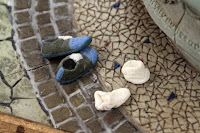 |
| . . . there will be shoes and socks nearby. |
 |
| You can read Kousuke's score . . . |
 |
| . . . and identify his piano manufacturer. |
 |
| And if you look closely at this tiny table, you realize . . . |
 |
| . . . the boy is playing with the toast . . . |
 |
| . . . and the eggs look pretty tasty! |
 |
| Even this self-portrait, Toyo says, is accurate . . . |
 |
| . . . as to Tombo's costume while working. |
We are enthralled. The tableaux seem to capture his subjects’ essences. He has observed them closely, and fashioned the tableaux with tremendous concentration and craftsmanship. His irrepressible humor ("He’s always got some damn dog pissing on someone, or whatever!" someone exclaimed) and the very real humanity of his figures make for a rich mixture. Each tableau not only sets a scene but articulates with rare clarity the figures’ relationships to each other and their environments. Their preoccupations and obsessions. Their individuality. In Salem he’d have been burned for witchcraft, I think.
But we are a long way from Salem. Tombo is having a good time, appreciating the appreciation visitors are displaying toward his little creations. So are we.
Then we leave. We have an afternoon to further explore Kyoto.
Somewhat randomly, I've suggested we try to find Daitoku-ji. It's an important Zen Buddhist temple in one of the two major Zen schools, Rinzai, and is famous for its screen paintings and zen gardens. All I really know about it is that, and that it's tied to Sen no Rikyu and the development of Japanese tea ceremony customs.
When we get there, we find that Daitoku-ji (founded in 1310, reconstructed after suffering damage during a war during the mid-15th Century) is a maze of sub-temples, about which I know nothing. A passing Frenchwoman says her husband says Daisen-in and Ryogen-in are two of the most interesting or most beautiful, so we visit those two -- starting with Ryogen-in because we're right near it. (We also visit a third -- Zuihoin, I think -- on our way out.)
It's quiet here. There are not the throngs of visitors who surrounded us at the places we visited a few days ago. These are places to appreciate in relative solitude, and we do.
 |
| Portion of garden at Zuihoin |
Ryogen-in
(1502) features five completely different gardens. There are few visitors today. Ryogen-in is lovely and silent. In one room, I contemplate what is said to be Japan's oldest gun, a musket made in 1583, and (with more interest) a go-board on which Hideyoshi and Tokugawa Ieyasu are said to have played a game. (Readers of James Clavell's fine novel
Shogun will recall Tokugawa Ieyasu.) Then we just sit quietly, cotemplating a small garden of stones with small trees. The stones are carefully raked, the trees carefully pruned.
The gardens are each beautiful. One, Ryugin-tei, would be impossible in our desert: it's covered with moss. Another, Totekiko, is said to be the smallest Karesansui garden in Japan, but was added only in 1958.

Daisen-in was founded in 1509 by Kogaku Sotan, who headed one of the two major Japanese Zen Buddhist sects. It is famous for its gardens -- particularly the one that imitates a Chinese landscape painting and contains rocks representing, in miniature, a waterfall, the flow of a river, a turtle trying to swim upstream, and even a sleeping cow.
The turtle represents the futile effort we all make to swim against the sweep of time, holding on to our attachments. (No pictures though, because they make us turn in our cameras at the entrance. Can't entirely blame 'em for that. People teach and meditate here.
Shouldn't be attached to capturing images with a camera anyway.)

At Daisen-in, a round-faced Zen monk is signing his books, which are on sale that day there. It is also his 81st birthday -- and, involved as we are with the health problems of an 81 year-old friend in Dona Ana County, we notice the monk's good health and good cheer. (He's a good deal more vigorous than the photograph suggests.)
He turns out to be Souen Ozeki, the former head monk here. One of the books is
Introduction to Zen - How to do Zazen, co-authored with Elizabeth Mills. A second, with Mizuno Katsuhiko, is an illustrated book on Daisen-in and its gardens (but most of the text is in Japanese).
Behind him there's also a large quotation from him, to the effect that we can depend only on this present moment and should live in it.
I happen to be wearing a T-shirt bearing an image I created long ago, with a similar sentiment cribbed from Dogen, a 13th Century monk, born in Kyoto, who founded the Soto school of Zen in Japan, after extensive travel and study in China. The two major schools of Zen in Japan are Rinzai and Soto. We're in a temple associated with the Rinzai school.

I first read Dogen's phrase in 1985, while hurtling East on a train in northwest China. Hard sleeper, which meant there were six not-too-soft berths, three on each side with a small pull-up table against the window between the two stacks of berths. It wasn't quite a compartment, because there was no wall or door separating anyone from the aisle that ran down the middle of the car. I was reading. I read this quote from Dogen, "Do not rely on tomorrow . . ." At precisely that moment, as if to emphasize the wisdom of that thought, the train jammed to a halt on a bridge. Immediately beneath our window an elderly Chinese peasant in a blue jacket (a woman, I thought, but I was not certain) lay dying, having apparently been hit by the train. A widening little pool of piss or blood (I've forgotten which) spread from beneath her. Men from the train and perhaps some local men exchanged cigarettes and stood around for awhile smoking and talking. I guess someone took the body away. Pretty soon we were rolling again. Okay, got it.
In one of his waka, or tanka (five-line poems, from which the haiku derived, which happen also to be a favorite form of mine), Dogen writes:
Rising, as the mountain
peaks and valleys deepen --
the twilight sound of the cicada
singing of a day
already gone by.
(Translation by Steven Heine. There's a Soto Zen Center in Albuquerque.)
One of my own attaches itself to this photograph, taken moments after our brief conversation with Souen Ozeki.:
 |
See this tree's shadow?
Never again will this be
just as it is now.
Sun moves, clouds pass, the tree grows . . .
Tomorrow, are you still you? |

We meet Ozeki Souen only very briefly, but he appears full of the joy I might hope to find in a zen monk. The temples themselves I enjoy. I have read a fair amount about Zen Buddhism, though (shamefully!) never practiced it. (Since sitting zazen is everything, I am nothing.) I enjoy walking through these temples and seeing the meditation halls, where the monks lived, where young monks visited their teachers to discuss koans. I enjoy the sense of peace and history I feel walking through them. The grace and simplicity of the architecture, the spareness of the rooms, the dark old wood floors, and the gardens would seem conducive to meditation. I wonder how it would have been to front up at one of these places in my youth and seek admission. (Of course, if I really wondered I guess I'd reread Janwillem van de Wetering's short account of doing just that, and staying for a year or so. Dutch writer whose detective fiction I much enjoyed, who lived his last years in Maine. [
The Empty Mirror: Experiences in a Japanese Zen Monastery, 1971.])
Back in Osaka, when I look through the zen book, some of its contents are familiar to me; but his commentary on Nanzen's Cat summarizes, more simply and directly than I recall having read elsewhere, the significance of that story.
Nanzen, finding the priests of the eastern and western halls had quarreled over a cat, seized the cat and told the squabbling priests, "If any of you say a good word, you can save the cat. If not, I will cut it." No one answered, so Nansen sliced the cat in half with his sword.
That evening Joshu returned, and Nansen told him aabout the incident. Joshu removed his sandal, put it on top of his head, and walked out.
Nanzen commented, "If he had been there, he could have saved the cat."
I have read the koan often. (I have also contemplated its echoing of King Solomon's discovery of the true mother of an infant by offering to settle the matter by slicing the child in half. The similarity and distinctions between the two stories are proably worth a moment's thought some time.) The cat, or the priests' desire for it, symbolizes our human inability to dispense with
attachment to things. Zen is meant to help us overcome that inability, but obviously these particular priests hadn't quite accomplished that.
Ozeki's comments succinctly: "The odd action of Joshu is a warning that we must not hold fast to any idea."
By contrast, the famous Mumon commentary is "Why did Joshu put the sandals on his head? If anyone answers this question he will understand exactly how Nansen enforced his edict. If not, he should watch his own head." As is not unusual, it adds nothing to one's intuitive understanding of the incident. Another ancient comment: "Even Nansen's knife can never kill the Fundamental Wisdom. It is ever alive even at this very moment." A third: ":What Nansen killed was not only the cat concerned, but cats called Buddhas, cats called Patriarchs, are all cut away." (It's a pretty famous koan. Donald Ritchie reports that when, as a young man in the U.S. Army occupying Japan after the War, he was privileged to meet D.T. Suzuki, Suzuki greeted him, on each of quite a few visits, with this koan.)
There is grace and humor in Joshu's action. So much of what is important in life is difficult to fit into words -- or, upon being squeezed into words, ossifies, as followers (of Buddha, of Christ, of Mohammed) cling to the words and not their spirit or true meaning. Zen recognizes that. Joshu's action expresses the absurdity of attachment in a way that (although, ironically, repeated in countless retellings, including this one, over centuries) works at that moment in that context.
"Treasure every meeting, for it will never recur."